




































Highlights
A skilled Ayurvedic practitioner does not work from a single fixed checklist. When you sit down for an assessment, what looks like a relaxed conversation is actually a careful, layered reading of the whole person. The practitioner is watching, listening, feeling, and asking, and drawing on several frameworks that Ayurveda has refined over a very long time.
A Vaidya (Ayurvedic practitioner) has more than one way to understand you. Three assessment methods are the most widely known, and each one offers a different kind of insight:
- Trividha Pareeksha (the threefold examination)
- Dashavidha Pareeksha (the tenfold examination)
- Ashtavidha Pareeksha (the eightfold examination)
These methods did not all appear at once. They developed across many centuries, and looking at them together is the best way to see how thoughtful and individualized a true Ayurvedic assessment really is. They are assessment tools, chosen and combined to suit each person's assessment and are never a rigid sequence that every practitioner must follow.
A Measure of Health, Not Illness

An Ayurvedic assessment is not only a hunt for what has gone wrong. It is a measure of health itself.
Rather than cataloguing signs of illness, Ayurveda describes what vitality looks like in a living person: a steady pulse, a clear tongue, bright eyes, warm and supple skin, an even voice, sound digestion, and a strong, well proportioned body. The practitioner is reading how fully a person expresses balance, energy, and ease, and how far they stand from their own natural state of wellness.
This is why the same assessment tools serve everyone, the thriving and the struggling alike. They do not search for illness so much as measure the presence of health, which is the truest foundation for guiding a person back toward balance.
What Every Assessment Reaches For
Before exploring the three methods, it helps to know what a practitioner is actually looking for. No matter which framework is used, every assessment is reaching toward the same three things:
- Prakriti (natural constitution at birth): the unique balance of Vata (Air energy), Pitta (Fire energy), and Kapha (Water energy) you were born with
- Vikriti (current state of imbalance): how that natural balance has shifted overtime
- Agni (digestive fire): the strength of your digestion and your ability to turn food into nourishment
The whole process is part of what Ayurveda calls Rogi Pareeksha (examination of the individual). Think of it as a rich toolkit rather than a checklist.
Trividha Pareeksha: The Three Foundations

The threefold examination is the foundation everything else rests upon. It comes from the Charaka Samhita, a text compiled roughly two thousand years ago from oral teachings much older, which makes these three the original gateways of assessment in Ayurveda.
Trividha Pareeksha names the three fundamental ways a practitioner gathers information:
Darshana (observation): what the practitioner sees, from complexion and posture to the light in the eyes to the quality of voice
Sparshana (touch): what the practitioner feels through gentle touch and palpation, such as the warmth or dryness of the skin
Prashna (questioning): what the practitioner learns through conversation about your history, routine, and how you feel
Every other method, including the eight physical windows described later, is really a refinement of these three simple and timeless ways of knowing a person.
Dashavidha Pareeksha: The Tenfold Assessment of the Whole Person

If the threefold method describes how a practitioner gathers information, the tenfold method describes what is evaluated about you. This too comes from the Charaka Samhita, which makes it one of the original and most complete frameworks in Ayurveda, and arguably the heart of a thorough assessment. It looks at ten factors, each one adding depth to the portrait.
Prakriti (Natural Constitution): The inborn balance of Vata (Air energy), Pitta (Fire energy), and Kapha (Water energy) that shapes both body and temperament. This reveals the baseline you are working from, the version of you that is naturally in balance.
Vikriti (Current State of Imbalance): How your present condition has moved away from that baseline. This reveals what actually needs attention right now, as opposed to what is simply your nature.
Sara (Quality of the Tissues): The excellence and vitality of the body's tissues, known as Dhatus. This reveals your underlying constitutional strength and how resilient the body is at a deep level.
Samhanana (Body Build and Compactness): How well the body is put together, including the firmness of the frame, joints, and overall structure. This reveals sturdiness and the capacity to withstand physical strain.
Pramana (Proportion and Measurement): The proportion and measurement of the body and its parts. This reveals balanced development and offers another quiet marker of overall vitality.
Satmya (Suitability): What you are suited to and accustomed to, across food, climate, and daily habits. This reveals your adaptability and helps the practitioner understand what genuinely supports you as an individual.
Sattva (Mental Strength): The strength and steadiness of the mind. This reveals how you tend to meet stress, discomfort, and challenge, since a calm and steady mind is itself a source of resilience.
Ahara Shakti (Capacity for Food and Digestion): How much you can comfortably eat and how well it is digested. This reveals the strength of Agni (digestive fire) and shows what the body can realistically process and absorb.
Vyayama Shakti (Capacity for Activity): The body's strength and stamina for exertion. This reveals physical resilience and helps the practitioner suggest the right pace and intensity of activity for you.
Vaya (Age): Your stage of life. The energies naturally shift across a lifetime, from the Kapha (Water energy) of childhood, to the Pitta (Fire energy) of the active middle years, to the Vata (Air energy) of the later years. This reveals what is appropriate and balancing for your stage of life.
Taken together, these ten factors allow a practitioner to see you as a complete person, with a history, a constitution, a mind, and a stage of life, rather than as a single complaint.
Ashtavidha Pareeksha: The Eight Physical Windows

The eightfold examination is the most recent of the three methods. It is described in detail in the Yogaratnakara, a compilation from the seventeenth century, roughly three hundred and fifty years ago. Its prominence reflects a later flowering in Ayurveda, when pulse reading and close physical observation became especially refined arts.
These eight are specific, observable signs that deepen what the practitioner sees and feels:
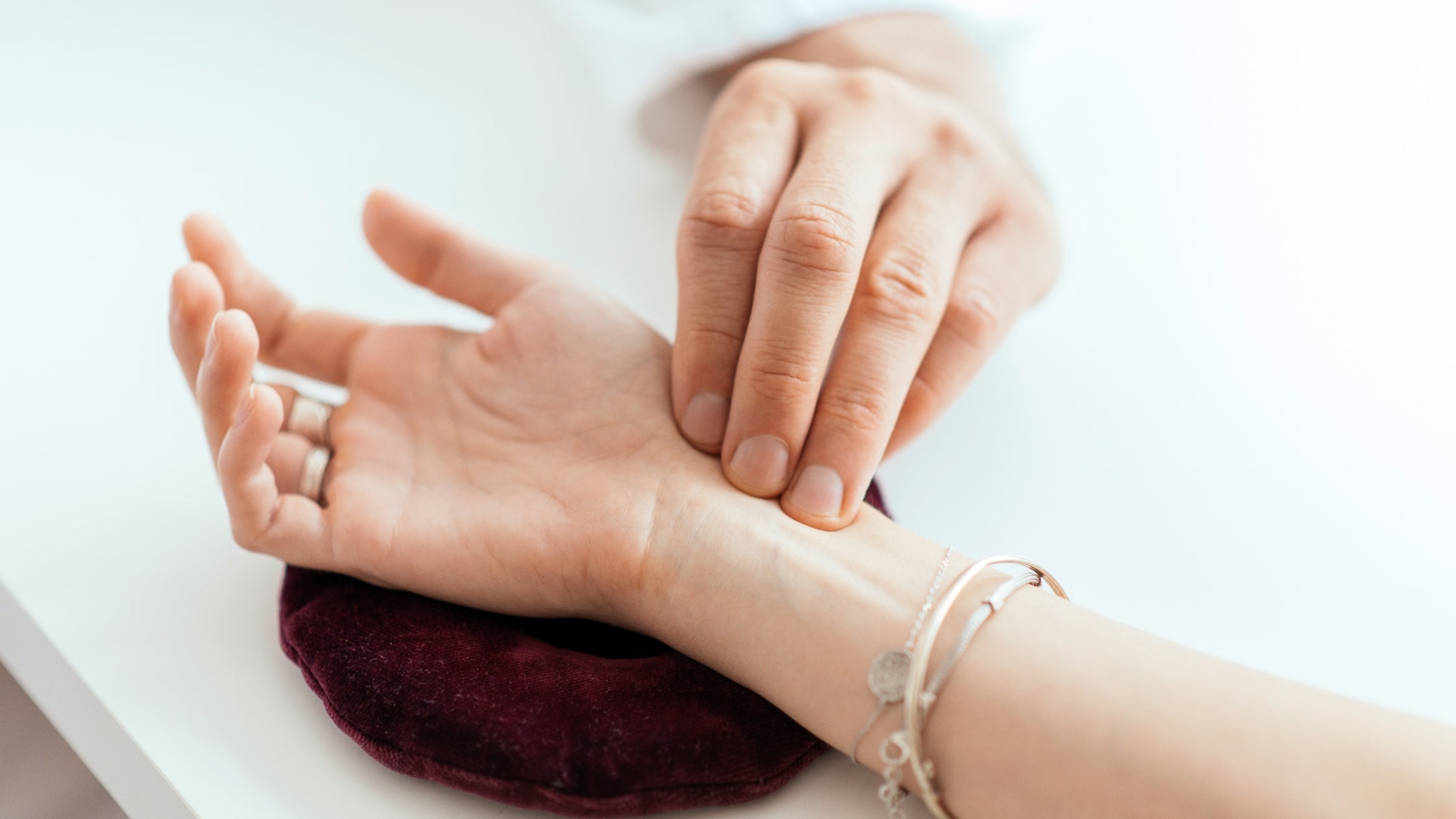
Nadi (pulse): the rhythm and quality of the pulse, read with three fingers at the wrist, showing which energy is most active
Mutra (urine): the color and clarity of urine, reflecting elimination and inner heat
Mala (stool): the form and quality of stool, showing digestive strength and the presence of Ama (undigested residue that behaves like an inner toxin)
Jihva (tongue): the coating, color, and texture of the tongue, mirroring the state of Agni (digestive fire)
Shabda (voice): the tone, pace, and quality of the voice, which carries the signature of the energies
Sparsha (touch): the temperature and texture of the skin, felt through gentle touch
Drik (eyes): the color and luster of the eyes, reflecting overall vitality
Akriti (general appearance): the overall build and the general impression of strength and balance
A Note on the History of Pulse Reading

The history of Nadi (pulse) reading tells a great deal about how Ayurveda has grown over time. Although the pulse is often the first window a practitioner turns to today, it is actually one of the most recent additions to the tradition. The foundational Charaka Samhita does not describe pulse reading as a method of assessment at all. Its single mention of the pulse simply notes that the “stilling of the great vessel at the neck is a sign that life has ended”.
Pulse reading as a living art was first documented much later, in the Sharngadhara Samhita of roughly the thirteenth century, which drew the link between the pulse and the balance of Vata (Air energy), Pitta (Fire energy), and Kapha (Water energy). It was developed further in the sixteenth century Bhavaprakasha, and given its fullest description in the seventeenth century Yogaratnakara, where it has forty eight verses. So the examination a practitioner now reaches for first is, in the long history of Ayurveda, a relatively young one.
A practitioner draws on these tools as they are relevant. Not every tool is utilized at every visit, and the choice of what to look at closely is part of the practitioner's skill and the art of Ayurveda.
How These Methods Work Together
These three methods are not a fixed order on a checklist. They are tools, and a practitioner combines them to fit the person and the moment. A first visit for a longstanding concern may draw on all ten factors of the tenfold method, while a focused follow up may rest on the three foundations and a quick reading of the pulse and tongue. This is why two Ayurvedic assessments rarely look alike, even for the same complaint, and it is where the art of the Ayurvedic practitioner truly lives.
Modern research has taken a sincere interest in these methods as well. Studies exploring pulse wave analysis, for example, have begun to examine the very patterns that Nadi (pulse) reading has interpreted by hand for centuries.
What an Assessment May Include

Every practitioner adapts to the person, yet most assessments share a familiar shape:
A relaxed conversation about health history, daily routine, digestion, sleep, and current concerns.
- Observation of general appearance, complexion, and the voice
- A reading of the pulse, the tongue, and the eyes
- Gentle touch to read the temperature and texture of the skin
- A drawing together of all findings into a clear picture of constitution and current balance
- Personalized guidance on food, daily rhythm, and herbal support
Learn Ayurvedic Assessment and Pulse Diagnosis
For those who feel drawn to learn these methods firsthand, Kerala Ayurveda offers a workshop devoted to exactly this art: Ayurvedic Assessment and Pulse Diagnosis.
Over three days, students explore the traditional assessment methods drawn from the Vedic texts, including Trividha Pareeksha (the threefold examination), Ashtavidha Pareeksha (the eightfold examination), and Dashavidha Pareeksha (the tenfold examination), then move into hands on practice with live cases. The workshop covers:
- Pulse reading through its many layers, and how it reflects Prakriti (natural constitution) and Vikriti (current state of imbalance)
- Tongue assessment for reading the body's systems
- Additional points including the eyes (Netra), skin (Twak), nails (Nakha), hair (Kesa), stool (Mala), urine (Mutra), voice (Shabda), and overall structure (Akriti)
- Mapping Samprapti (the pathway an imbalance takes) from beginning to end
The workshop runs October 9 through 11, 2026, offered both in person in Milpitas, California, and by live stream. It welcomes Ayurvedic students and professionals, as well as anyone new to Ayurveda who completes the listed prerequisites. Members of NAMA can also earn PACE continuing education credits, and discounted rates are available for current Kerala Ayurveda students and alumni.
In Closing

What makes Ayurvedic assessment so valuable is not any single method. It is the skillful way a practitioner moves among them, choosing the right tool for the right moment and weaving the findings into an understanding of you as a whole person. Thoroughness here comes from flexibility, not from a fixed routine.
If reading this has made you curious about what an unhurried, personalized assessment might reveal about your own constitution and balance, the Vaidya’s (Ayurvedic practitioners) at the Kerala Ayurveda Wellness Center would be glad to welcome you. Each one brings a depth of skill and every assessment is shaped around the individual who walks through the door.

References
Ayurvedic Sources
- Charaka Samhita, Vimana Sthana, Chapter 4. The source of Trividha Pareeksha, the threefold examination (Darshana, Sparshana, Prashna).
- Charaka Samhita, Vimana Sthana, Chapter 8. The source of Dashavidha Pareeksha, the tenfold examination of the individual.
- Yogaratnakara (seventeenth century), Purvardha. The text describes Ashtavidha Pareeksha, the eightfold examination, in detail, and gives the fullest account of Nadi Pariksha.
- Sharngadhara Samhita (roughly the thirteenth century). The earliest Ayurvedic text to formally document Nadi Pariksha, the examination of the pulse.
- Bhavaprakasha (sixteenth century). Further development of pulse examination in Ayurveda.
Published Studies and Reviews
- Traditional practices and recent advances in Nadi Pariksha: A comprehensive review. Available via PubMed Central (PMC6938838).
- Pulse (Nadi) Analysis for Disease Diagnosis: A Detailed Review. Proceedings of the National Academy of Sciences, India Section A: Physical Sciences, Springer, 2022. DOI 10.1007/s40010-022-00800-0.
- Jivha Pareeksha: An Ayurvedic Diagnostic Tool, A Review. International Research Journal of Ayurveda and Yoga, Volume 7, Issue 8, pages 21 to 25, August 2024.
- Importance of Ashtavidha Pariksha. Journal of Emerging Technologies and Innovative Research (JETIR), Volume 8, Issue 9, September 2021.
Related Products



Herb Infused Ghee for Focus and Memory



Ksheerabala Thailam is a favorite in Panchakarma treatments. It's a classic Ayurvedic foot massage oil traditionally used to naturally cleanse the body from unwanted toxins, lull the body into a state of rest, and rehydrate an area prone to dry skin. Ksheerabala Thailam's toasty notes come from its toasted sesame seed oil base, a topical ingredient used for centuries for its natural analgesic and anti-inflammatory properties and unique ability to minimize the severity of deep aches.